Wednesday, November 24, 2010

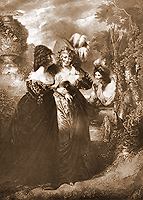
Summary from Act 1 through to Act 3

Act One
In Act 1, Leonato, his wife Innogan, his daughter Hero and his niece Beatrice along with a messenger enter discussing the recent war. In more detail, Leonato and the messenger talks about the war and how Don Pedro bestowed much honor to a male called Claudio who fought well. However, in Beatrice's interest is none other than a Signor Benedict whom, it is shown to the audience, she dislikes because of their different views on love. She constantly insults him names while conversing with others and also to his face. They both insult each other to a point where they think that they have become bitter enemies.After Leonato and his family left, Claudio confides in Benedict and Don Pedro about his feelings for Leonanto's daughter Hero. Benedict does not like the fact that Claudio is in love but Don Pedro is very much interested and wants his love to prosper. They devised a plan that at a masked ball that was planned, Don Pedro would pretend to be Claudio in order to woo Hero and they would eventually marry. 
Leonato and Antonio, brothers, converse where Antonio tells him of the plans that Don Pedro and Claudio made.  Though some thought of this as good, Don John, Don Pedro's bastard brother, upon learning of their plan, thought of a plan of his own to ruin his brother.

Act Two
After Leonato inquires about Don John upon him  not showing up at dinner after being invited, a conversation is mounted up upon the looks of Don John by Beatrice. This ultimately turns into her insulting Benedict, comparing him to Don John. Her father, Antonio shares his fears that his daughter is cursed because of her hatred to love. Even Leonato tries to convince her without success.
Don  Pedro, Claudio, Benedick and Balthasar enter as well as Don John, Borachio to the masked ball. Don Pedro insists that he take Hero for a  walk. Balthasar and Margaret, gentlewoman attending to Hero, also have a discussion on love. And Antonio denies that he is in fact Antonio to another gentlewoman to Hero, Ursula but she is convinced that he is Antonio.Meanwhile, as has become the norm, Beatrice and Benedict seems to find something to disagree upon however, she knew that it was Benedict himself and decided to play along with his little game. Everyone else went dancing and Don John and Borachio devised their plan and approached Claudio, knowing that he was very well Claudio, pretending to be Benedict. They explain that Don Pedro is in love with Hero and plans to woo her for himself. Claudio believes and is so upset that he thinks that he is no longer in love with Hero. Claudio does not even want to speak with Benedict. Benedict explains to Don Pedro that Claudio seemed very sad and left because he thought that Don Pedro was wooing Hero for himself. But he assured Benedict that it was only for Claudio. He also said that Beatrice told a fellow whom she danced with of "bad Benedict". Benedick is so outraged at seeing Beatrice that he asks Don Pedro for a transfer out of his command. When he is turned down, he leaves the scene. Beatrice brings Claudio to Don Pedro and hints at jealousy as the root of Claudio's anger. Don Pedro explains that he wooed Hero in Claudio's name and that all marriage arrangements are made. Hero and Claudio kiss and become a happy couple. Don Pedro asks Beatrice to marry him, but she turns him down by saying that his position in life is too great for her. She does not want to marry a prince. She wishes her cousins happiness and leaves. Don Pedro decides that Beatrice and Benedick are a perfect match for one another, for they are both stuffed with a large tongue and quick wit.

Act Three
Hero, Margaret, and Ursula plan to begin their manipulative work on Beatrice. Hero tells Margaret to run and get Beatrice to come to the orchard so that she will overhear her conversation with Ursula. Hero and Ursula begin to speak of Benedict and his great name and excellent virtues. Hero says that she can never tell Beatrice of his love for her because she is unable to love. Hero says that she will try to convince Benedick not to love Beatrice because Beatrice is too witty and strong to love another.  Claudio, Benedick, and Leonato discuss the prince's visit in Leonato's house. Benedick tells the men that he is changed. Don Pedro and Claudio tease him and question him until they realize that he is in love. They mockingly express shock at this sworn bachelor's new passion for a woman. Benedick leaves with Leonato to discuss Beatrice's betrothal. Don John lies to Pedro and Claudio about Hero's supposed disloyalty. He tells them about Hero's affair with Borachio and pretends to show feelings. They decide if John is correct about Hero's disloyalty, then Claudio and Don Pedro plan to disgrace her in public at the wedding in the next morning.

Wednesday, November 17, 2010

Questions on Much ado about nothing

1. Don John vowed to overthrow his brother Don Pedro and ruin the plans that Don Pedro and Claudio made to woo Hero.
2. Claudio is in love with Hero, the heir to Leonato.
3. Beatrice and Benedict both thinks that love is a waste of time fro them both.
4. The plan executed by Don Pedro was to pretend to be Claudio and woo Hero in order for her to get married to him (Claudio).

Wednesday, November 10, 2010

The life and tines of William Shakespeare


The Early years of William Shakespeare
William Shakespeare was born in Stratford-Upon-Avon which was in Warwickshire County and is said to have been born in April 1564. This was so because in the Elizabethan era,one was baptized three days after being  born. Shakespeare is said to be baptized on the 23rd of April 1564, therefore he was suspected of being born on the 20th of April 1564 (however this was not confirmed).  In Latin, his name was Guilielmus Filius Shakspere. It means William, the son of Shakespeare. He was the third of seven children born to John Shakespeare and Mary Arden. John Shakespeare was an official local businessman who made gloves and purses. He was also involved in local politics. His mother Mary Arden, was the youngest daughter born to her parents, and inherited much of her father's land owning and farming estate when he died. There were no known records of Shakespeare attending school because only the names of wealthy individuals were recorded. However, it is assumed that Shakespeare attended the King's New Grammar School, because there, male students of Stratford-Upon-Avon normally attended. Because of this, there was a debate which was based on his very existance.


William Shakespeare's love life and children
In 1582 William Shakespeare got married to a woman named Anne Hathaway. A bond certificate dated 28th November 1582 suggests that 18 year old William married his older spouse Anne who was a 26 year old pregnant woman. Almost seven month after they had their first child together, Susanna. Records show that she was born in May 1583. In February 1592, it is shown that together, the Shakespeare's had Hamnet and Judith, the twins. However, sadly, Hamnet, Shakespeare's only son died in 1596, at the tender age of 11.  Anne never left Stratford-Upon-Avon and lived there for her entire life. 


 William Shakespeare and his work
In 1609, Shakespeare's sonnets were published without permission. It is considered unlikely that he wanted many of his deeply personal poems to be revealed to the outside world. It was not however the first time; in 1599, in a collection entitled "The Passionate Pilgrim" , two of his poems had been printed without Shakespeare's permission.
Records with the College of Heralds, reveal Shakespeare applied for a coat of arms. Despite a lack of proof, he was granted his request. Later in 1599 he applied for his mother’s coat of arms to be added to his own.
At age 15, Shakespeare purchased the New Place. This was one of the most prominent and desired properties in all of Stratford-Upon-Avon being the second largest house in town; the first one being the mayor's. Given his father's known financial hardship from 1576, Shakespeare must either have used his own money to buy this expensive property or his father had placed money in his son’s name. It is possible that Shakespeare might have bought this prominent property with money from his plays. It is estimated that roughly fifteen of his 37 plays would have been written and performed by 1597. Shakespeare is estimated to have written 42 plays not including his other work which included almost every aspect of human experiences. Such are comedy, tragedy, history, and poetry.

William Shakespeare: The greatest playwright
Shakespeare's works have been a major influence on subsequent theatre. Not only did Shakespeare create some of the most admired plays in Western literature, he also transformed English theatre by expanding expectations about what could be accomplished through characterisation, plot, action, language, and genre. His poetic artistry helped raise the status of popular theatre, permitting it to be admired by intellectuals as well as by those seeking pure entertainment. Shakespeare died on

The Elizabethan era
This is the era of the reign of Queen Elizabeth (1558-1603). During her reign,the graphic arts, theatre and literature flourished. William Shakespeare was the most famous writer in this time. It was the age of expansion  and exploration abroad. This period is highly viewed because of the periods before and after. England was a centralized well-organized and effective government during this period. Economically the country began to benefit greatly from this highly favored era.

The Global Theatre
A theatre in London associated with William Shakespeare. Built in 1559, by Shakespeare's playing company, the Globe theatre was destroyed by fire on the 29th of June 1613. A second Globe theatre was built on the same site by June 1614 and was officially closed in 1642. Shakespeare's theatre group was called the "King's Men", and extract from the Globe theatre. Thomas Green wrote an article on Shakespeare saying that he was an "upstart pro who wanted to 'Shakescene'. A modern reconstruction of the theatre renamed "Shakespeare's Globe" was built and opened in 1997.  


Wednesday, November 3, 2010

Questions on Brother Man

1. Some conflicts in Brother Man are:

  • between Girlie and Papacita. From the beginning through to the end of the novel we are shown that they were so much in love that they ended up disliking each other causing disharmony between them. Girlie would not give in to Papacita's commands and he would not back down.
  • between Brother Man and Bra' Ambo. It was clearly shown that Bra' Ambo disliked Brother Man because he refused to hide his 'things' from the police. From that time onwards, as shown in the novel, Bra' Ambo tried his very best to bring harm to Brother Man.
2. Internal conflict in literature is what conflict which takes place with the character's mind. It a technique used by authors.
External conflict in literature is any conflict in which characters have with each other. It is also a technique used by authors.

3. Three types of irony are:

  • Dramatic
  • Verbal
  • Situational
4. In the book Brother Man irony is played out through Brother Man. In the beginning of the novel Brother Man is seen as a person who is adored by all but as the novel progresses to the end he is ridiculed and beaten and is seen as a bad person.

5.

Pigotts Village
St.Georges 
Antigua
3rd November 2010
Timothy Payne, Managing Editor
Antigua Sun
Coolidge 
St.Johns
Antigua W.I.

Dear Mr. Timothy Payne:
            I am writing to you to inform you of the beating of John Power a.k.a Brother Man for I was an eyewitness. I write with the confidence in you that I will remain anonymous in any publishing that will be done.

The harming of Brother Man, in my view, was not necessary because he had done nothing wrong. The mob was not sure if he (Brother Man), himself performed the violent acts of rape, murder, theft and counterfeiting. They should not have jumped to such fast and harsh conclusions until they listened and heard what he had to say. Let him have a chance to defend himself. After all, he did help many if not all of them be it financially or through his healing at some point.

Personally, my heart goes out to Brother Man and his loved ones. Especially to that poor old lady who tried to shield him from being beaten. She too was punched and kicked in her ribs until she bled and was left in the gutter. He was wrongfully accused and was punished for actions in which he did not commit. However, the mob was certain that because he was a Ras Tafari, he was just as guilty as any other Ras Tafari who commited any wrongful act themselves. Poor Brother Man. After all the good that he done, he received bad in return. The Bible says that you reap whatever you sow, but for Brother Man that was not so. It was like he was a replica of Jesus himself. It is ironic that he was so adored by everyone and because of lies he became one of the most hated person. 

The Ratafarians should be treated just as anyone else. They are humans and should not be seen as predators because of one's actions. The persons from the start did not like the Rastafarians because of their religion. For me, they are just people who wish to express themselves without being judged.  

Thank you for your time. Please be reminded that I would like to remain anonymous when publishing the story. 

Your Respectfully,
Erica Francis